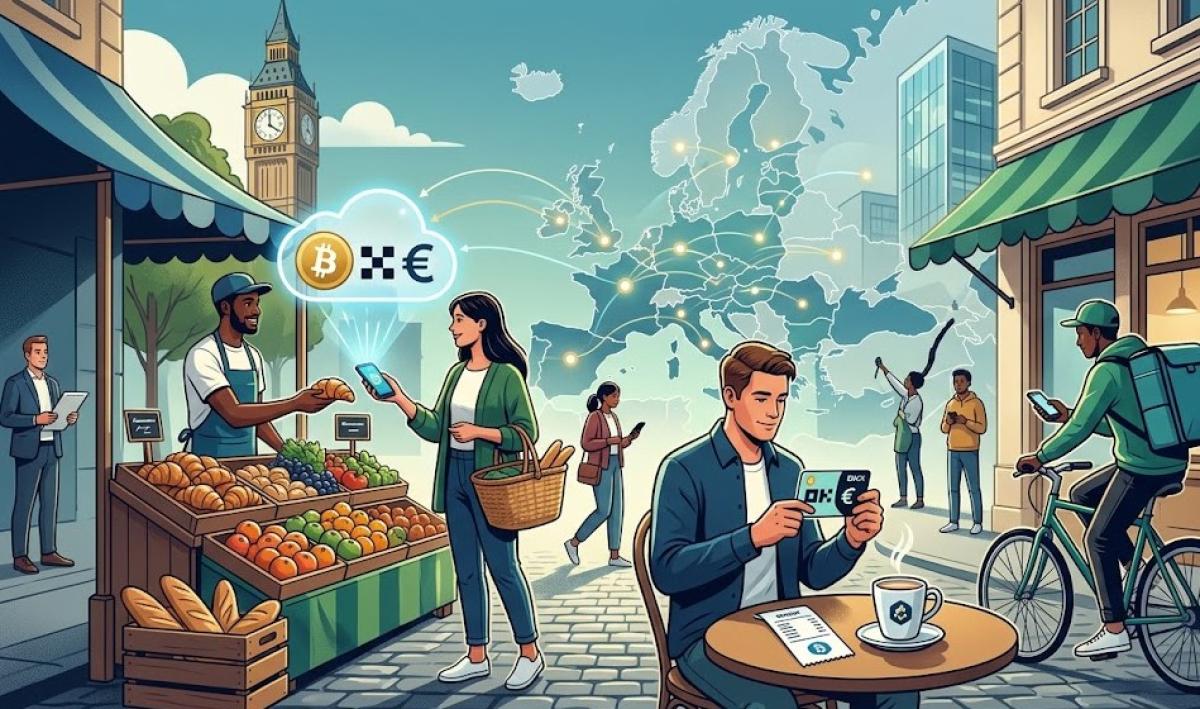
New transaction data from OKX indicates that cryptocurrency is increasingly being used for routine, everyday purchases across Europe, challenging long-held assumptions that digital assets are primarily reserved for high-end or speculative spending.
Everyday Purchases Dominate Crypto Card Usage
An analysis of the company’s payment card activity across the European Economic Area (EEA) shows that essential spending categories dominate early adoption patterns. In its first month of operation, the OKX Card was most frequently used for groceries, which accounted for 26% of total transactions. Dining-related expenses, including restaurants and fast food, followed at 18%.
The dataset reflects completed purchase transactions recorded between January 28 and February 26, covering the top 20 merchant categories based on volume, frequency, and user activity. It excludes peer-to-peer transfers but includes a wide spectrum of consumer spending, such as utilities and other recurring expenses.
This distribution suggests that crypto-linked payment instruments are increasingly integrated into daily financial behavior rather than being confined to occasional or luxury expenditures.
Distinct Spending Patterns Across European Markets
While aggregate figures point to a broader trend, national-level data reveals notable differences shaped by local consumer habits.
In France, bakery purchases represent a higher-than-average share of transactions, reflecting the country’s strong café and boulangerie culture. Germany shows a different pattern, with a significant portion of spending—around 30%—directed toward online marketplaces, far exceeding the regional average.
Meanwhile, the Netherlands leads in supermarket-related transactions, with 37% of card usage tied to grocery shopping. Poland stands out for frequent, low-value, in-person payments, particularly at convenience stores and fuel stations, both exceeding EEA norms.
These variations indicate that while crypto adoption is rising, it is adapting to existing cultural and economic behaviors rather than reshaping them entirely.
A Broader Shift Toward Routine Crypto Payments
According to OKX representatives, the findings reflect a behavioral shift where users are becoming more comfortable converting digital assets into fiat equivalents for daily spending. This marks a departure from earlier usage patterns, which often centered on large, infrequent purchases.
The trend is not isolated. Industry-wide data supports the same trajectory. A 2025 report by Cex.io found that nearly half of crypto card transactions in Europe involved amounts below €10, underscoring their role in micro and everyday payments. Additionally, around 40% of such transactions occurred online—significantly higher than the eurozone’s average for traditional card usage.
Further evidence comes from stablecoin activity. Data reported earlier this year showed that Spain has emerged as a leading market for euro-denominated stablecoin usage, with transaction sizes averaging under €50—again pointing to routine consumer spending rather than large-scale transfers.
Conclusion
The growing use of crypto cards for groceries, dining, and other daily expenses signals a maturation phase for digital assets in Europe. Rather than functioning solely as investment vehicles or tools for high-value transactions, cryptocurrencies—particularly when paired with payment cards—are increasingly embedded in everyday economic life.
If current trends persist, crypto-backed payments may continue to narrow the gap with traditional financial systems, not through disruption alone, but by quietly integrating into the rhythms of daily consumption.
Disclaimer: The data and/or information provided on this website is intended solely for general informational and reference purposes, and does not constitute financial, investment, trading, or professional advice of any kind.
All actions or decisions made based on the content of this website are entirely the responsibility of the reader. Any activity involving investments, trading, or the use of digital services carries inherent risks that may result in financial loss. Always conduct thorough research before making any decisions.
This website may include links to third-party platforms or external sites. We do not control and are not responsible for the content, policies, or activities of those external parties.
By accessing and using this website, you acknowledge and agree that all information is used at your own risk.